








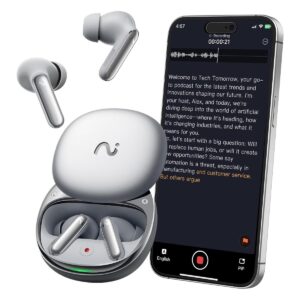
Most people who need hearing help put it off for years, and the reason is rarely the money — it is not wanting to wear something that announces it. The LINNER Mars solves that by not looking like a hearing aid at all. It looks like a pair of wireless earbuds, because it is also a pair of wireless earbuds.
Two devices in one shell
In hearing-aid mode it amplifies and shapes the sound around you — speech in particular — so conversation at a table or in a shop becomes followable again. In earbud mode it pairs over Bluetooth 5.3 and plays music and calls like any other TWS set. Nobody looking at you can tell which mode you are in.
Noise cancellation and an ambient mode that both do real work
Active noise cancellation cuts fan noise, traffic and crowd hum — which for someone with hearing loss is not a comfort feature but the difference between hearing a sentence and not. Ambient mode does the opposite when you need to stay aware of the room.
Designed for all-day wear
Light in the ear and stable enough to forget, with a charging case that tops them up through the day rather than leaving you without them mid-afternoon. Bluetooth 5.3 keeps the connection steady across a room.
Over-the-counter, so there is no appointment to book
The Mars is an FDA-registered OTC hearing aid — designed to be bought and self-fitted for perceived mild to moderate hearing loss, without a prescription or a clinic visit.
- Dual function — OTC hearing aid and Bluetooth earbuds in one
- Speech-focused amplification for conversation
- Active noise cancellation plus ambient mode
- Bluetooth 5.3 for music and calls
- Charging case for all-day use
- Looks like ordinary earbuds — no visible hearing device
- FDA-registered over-the-counter device — no prescription needed
This is the exact set filmed for the review above, inspected before listing — which is why it is half the price of a new one. Watch the review to hear the difference between the modes, then wear them for a week of ordinary conversations.
OTC hearing aids are intended for adults with perceived mild to moderate hearing loss. They are not a substitute for an assessment by a qualified audiologist, and anyone with sudden, severe or one-sided hearing loss, pain, or discharge should see a doctor first.
Reviews
There are no reviews yet.